Austin, Texas
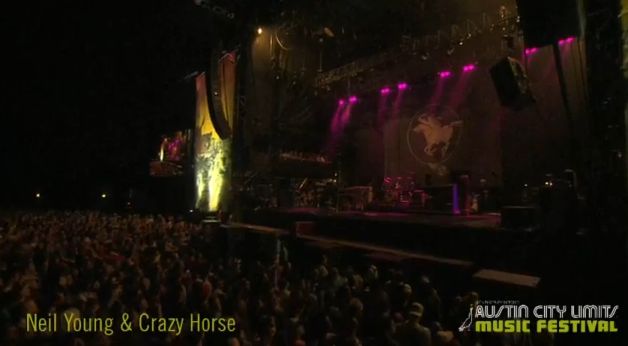
full show (1:21:37h) on Youtube, for those who missed it:

Neil Young
2012-10-13
Zilker Park, Austin, Texas, USA
Austin City Limits Music Festival
w/ Crazy Horse

01. Love And Only Love
02. Powderfinger
03. Born In Ontario
04. Walk Like A Giant
05. The Needle And The Damage Done
06. Twisted Road
07. Ramada Inn
08. Cinnamon Girl
09. F*!#in' Up
10. Psychedelic Pill
11. Down By The River
12. Hey Hey, My My (Into The Black)

Tour: 2012 Crazy Horse Tour
Band: Crazy Horse, Line Up 3

Neil Young - vocals, acoustic guitar, electric guitar
Frank Sampedro - electric guitar, vocals
Billy Talbot - bass, vocals
Ralph Molina - drums, vocals
see article on Human-Highway.org.
Neil Young’s book offers a glimpse of his life, music
By DAVID ULIN
Los Angeles Times
By Neil Young
Blue Rider Press; 502 pages; $30
NeilYoung’s “Waging Heavy Peace: A Hippie Dream” is surely one of the most idiosyncratic rock star autobiographies ever written.
A 502-page free-form series of digressions, it is by turns exhilarating and enervating, less a memoir than a self-portrait, with all the impressionism that implies.
On the one hand, “Waging Heavy Peace” is a mess — sprawling, improvisational, like a sloppy 40-minute jam on “Like a Hurricane.” But it is also revealing, even at times oddly beautiful, a stream-of-consciousness-meditation on where Young has been, where he thinks he’s going and, perhaps most revealing, where he is right now.
“Not that it matters much,” he writes, “but recently I stopped smoking and drinking. The big question for me at this point is whether I will be able to write songs this way. I haven’t yet, and that is a big part of my life. Of course I am now 65, so my writing may not be as easy-flowing as it once was, but on the other hand, I am writing this book. I’ll check in with you on that later. We’ll see how it goes.”
The smoking to which Young refers is, of course, weed, which he has long regarded as a key to his creativity. As such, his not altogether willing sobriety becomes one of the threads of “Waging Heavy Peace,” a through line that roots the book in the here and now.
Composed in 2011, during a period when Young had stopped making music, the memoir is as much a record of his creative doubts, his fears and uncertainties about growing older, as it is the story of his years with Buffalo Springfield or Crosby, Stills, Nash and Young.
“At this age,” he writes, contemplating another run with Crazy Horse, his longtime backing band, “I think relevancy is the big challenge. We need to be sure the new songs and music are ready and are meaningful to us. They are our ticket, our vehicle to the future, and without the new songs we are just reliving the past.”
As it turns out, the Crazy Horse reunion did happen; Young and the band released a cover record this year, and an album of new songs, “Psychedelic Pill,” comes out at the end of the month.
It is compelling to see a figure as prominent as Young — arguably one of the five or 10 most influential figures in the history of rock ‘n’ roll — express himself in such an unfiltered way.
This off-handed directness has long been the key to Young’s music; he’s as unpretentious as they come. Even “Trans,” his 1982 electronic album, had its roots in day-to-day experience, inspired by his son Ben, who was born with cerebral palsy and requires around-the-clock care.
And yet, Young is mercurial and easily distracted, as evidenced by the peripatetic nature of his career. He followed his most commercial record, 1972’s “Harvest,” with a suite of albums (“Time Fades Away,” “On the Beach,” “Tonight’s the Night”) known among his fans as the “Ditch Trilogy,” for their distance from the middle of the road.
He walked away from every group he ever played with, famously breaking up with Stephen Stills midtour in 1976 by sending Stills a telegram that read, “Funny how some things that start spontaneously end that way. Eat a peach, Neil.”
Tellingly, that anecdote doesn’t appear in “Waging Heavy Peace.” There’s a limit to the art of revelation, it appears. But it remains instructive, suggesting something about Young’s approach to this project as well.
Like his discography, it is a memoir without apparent shape — or more accurately, one whose shape emerges from its shapelessness, from its tendency to wander, from the ebb and flow of Young’s attention, from the play of memory.
In many ways, it unfolds in real time, with ruminations on his sobriety, on extra-musical projects such as the Lincvolt (an electric car) or PureTone (a system for reproducing digital sound in high fidelity) as well as ongoing updates on the book itself.
“I have been clean now for seven months,” he writes in one of the closing chapters. “That is a good long time. I still feel cravings … I haven’t written a song in more than half a year, and that is different for me. Of course I’ve written over ninety thousand words in this book, and that is different for me, too.”
IN PERFORMANCE
A howling Neil Young rocks United Center
Neil Young and Crazy Horse play at the United Center Thursday. (E. Jason Wambsgans/Chicago Tribune / October 12, 2012), Greg Kot Music critic, 9:59 a.m. CDT, October 12, 2012
Frank “Pancho” Sampedro, the longtime guitarist in Crazy Horse, is a barrel of a man. He wears the look of a retired linebacker who has put on a few pounds. But he went airborne Thursday at the United Center as he and Neil Young squared off and stomped around the stage.
Instead of hunching over his guitar, bending at the waist as he normally does, Young turned his instrument into a machine gun, his legs splayed, straw hair flailing. “I (messed) up again and again,” he roared, first raging, then pained, as if he were reliving some trainwreck moment from the past.
By the end, the singer was a demon-eyed street oracle howling at the audience. “They give you this, but you pay for that,” he spat, turning “Hey Hey, My My (Into the Black)” into an Occupy manifesto.
* Photos: Neil Young at United Center
Young and Crazy Horse have been an off-and-on proposition for more than 40 years, but Young has indisputably made some of his best – and most violent – music in the company of Sampedro, bassist Billy Talbot and drummer Ralph Molina.
Now they’re on the road for the first time in nearly a decade. A few props were resurrected from the late-‘70s “Rust Never Sleeps” tour – the giant amplifiers and parade-float-sized microphone serviced by lab-coated roadies. But that was about it for nostalgia. The quartet has released two new albums this year, and the set list Thursday brimmed with new songs, rejiggered arrangements and feverish intensity.
Make no mistake — the past kept creeping into the songs. The passage of time and how it twists perceptions and tests relationships is a major theme in Young’s new work. Wistfulness oozed from several songs, including the 17-minute “Ramada Inn,” in which a couple finds that even love isn’t enough to keep them from drifting apart. He shuts down, she pulls away, and time rolls on.
But there was nothing particularly genteel or overly familiar and comforting about this music. Like one of Young’s beloved trains, Crazy Horse is a large beast that tends to ease into its work. But once it gains its bearings and picks up speed, it’s awfully difficult to slow down. At least five of the 13 songs performed Thursday surpassed the 10-minute mark. “Love and only Love” began like an extended exhale before finding its pace, with Young, Sampedro and Talbot huddled in front of the drum riser. Whereas most bands spread out to fill a big stage such as the United Center’s, Crazy Horse bunches together, as if defending their home against invasion.
The group works itself into a trance-like frenzy, Young’s guitar piercing through a thicket of bottom-heavy tones and rumbling drums. For the relatively pithy “Cinnamon Girl,” the feedback that shut it down lasted nearly as long as the song itself. The band turned the period psychedelia of Young’s old Buffalo Springfield hit “Mr. Soul” into churning acid-punk. Molina’s drums on “Hey Hey, My My (Into the Black)” pumped like pistons in a factory.
Normally, the encore is a time of a celebration, of release. But Young and Crazy Horse instead shook loose the ghosts of the harrowing “Tonight’s the Night.” Expanded to 10 minutes, the song became a long, lonely howl for fallen friends, a séance. “Tonight’s the night,” Young whispered. “Yes, it is.”
 Shar on Neil Young at our fingertips
 Savana Lee on Anthony Crawford says Neil Young did nothing for me
 memphish on Neil Young Set List: 2012-10-25, Tuscaloosa Amphitheater, Tuscaloosa, Alabama, USA
 Sandra on Neil Young to Talk about LincVolt at SEMA
 Albert Stromann on RAW
 liza on Record store bootleg blues
 Baz on Record store bootleg blues